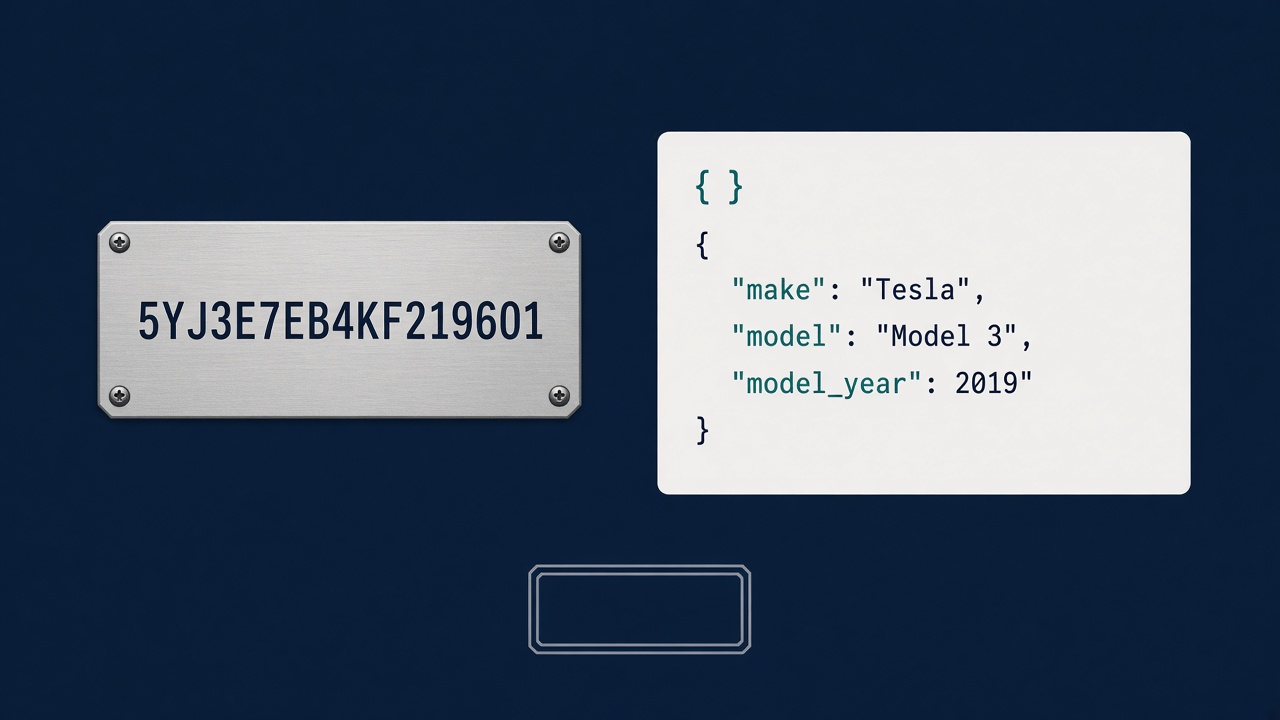
You have a VIN in hand and need a defensible market value for that vehicle in your app by Friday. In this guide, you’ll make a real request to the Vehicle Value Calculator API with curl, parse the JSON in Node.js, and understand the fields you can ship to production (average price, distribution bands, certainty, mileage adjustment, and more).
What the Vehicle Value Calculator API does
The Vehicle Value Calculator API estimates market prices for a specific vehicle identified by VIN and exposes supporting data such as the observed period, sample size, standard deviation, and a price distribution. It also provides helper endpoints to list supported makers and models.

Developers use it to power trade-in quotes, listing price recommendations, underwriting checks, and fleet remarketing dashboards. You supply a VIN, and the API returns core stats you can put directly into UI widgets or pricing logic.
Getting started on Zyla API Hub
All calls go through Zyla API Hub. Open the API’s listing, subscribe, and use the bearer token in your headers:
- Visit the marketplace item and click Start 7-day trial (or subscribe) to get your key: Start 7-day trial on Vehicle Value Calculator API
- Auth is via Authorization: Bearer YOUR_API_KEY
- Billing is subscription + quota (not pay-per-call). For a first integration, expect a 7-day trial or 50 requests. There is no Free Plan; check the API page for current access options and pricing.
Zyla API Hub hosts more than 10,000 public APIs under one account and one API key, so you can plug additional data sources into your stack without managing multiple auth flows.
Endpoints you’ll call
Below are the endpoints exposed by the Vehicle Value Calculator API on Zyla API Hub. Use exactly these URLs and methods, and pass your API key in the Authorization header.
Get Vehicle price data
Fetch price statistics for a given VIN.
- Method: GET
- URL: https://zylalabs.com/api/3624/vehicle-value-calculator-api/4063/get-vehicle-price-data
- Required query parameter: vin (string). Example: JNKCA31A61T027494
- Description: Insert a VIN to receive market pricing metrics. The API supports optional parameters such as mileage (km) in general, but only vin is documented here. The default mileage assumption is 50,000 km unless otherwise adjusted by the service.
Official curl sample:
curl -s -X GET "https://zylalabs.com/api/3624/vehicle-value-calculator-api/4063/get-vehicle-price-data?vin=JNKCA31A61T027494" \
-H "Authorization: Bearer YOUR_API_KEY"
Official JSON sample response:
{
"status": true,
"code": 200,
"data": {
"vin": "JNKCA31A61T027494",
"success": true,
"id": "2001_infiniti_i30_luxury",
"vehicle": "2001 Infiniti I30 Luxury",
"mean": 4427.14,
"stdev": 1066,
"count": 18,
"mileage": 100000,
"certainty": 91,
"period": [
"2024-06-15",
"2024-12-04"
],
"prices": {
"average": 4427.14,
"below": 3360.23,
"above": 5494.05,
"distribution": [
{
"group": {
"min": 2095,
"max": 2350,
"count": 2
}
},
{
"group": {
"min": 2350,
"max": 2690,
"count": 2
}
},
{
"group": {
"min": 2690,
"max": 3555,
"count": 2
}
},
{
"group": {
"min": 3555,
"max": 3999,
"count": 2
}
},
{
"group": {
"min": 3999,
"max": 4200,
"count": 2
}
},
{
"group": {
"min": 4200,
"max": 4250,
"count": 1
}
},
{
"group": {
"min": 4250,
"max": 4500,
"count": 2
}
},
{
"group": {
"min": 4500,
"max": 4990,
"count": 2
}
},
{
"group": {
"min": 4990,
"max": 5250,
"count": 2
}
},
{
"group": {
"min": 5250,
"max": 5697,
"count": 1
}
}
]
},
"adjustments": {
"mileage": {
"average": 153135.17,
"input": 100000,
"adjustment": 463
}
}
},
"message": "Data Fetched Successfully!"
}
How to read this:
- data.vehicle and data.id identify the vehicle.
- data.mean and data.prices.average are the headline average price. Units are numeric price values; use them as-is in your app. If you display currency, label it explicitly in your UI since the response does not provide a currency code.
- data.prices.below and data.prices.above define lower and upper price references around the mean.
- data.prices.distribution is a histogram across price ranges with min/max bounds and sample counts.
- data.count is the number of observations that informed the estimate. data.stdev is the price standard deviation.
- data.period contains ISO-8601 dates bounding the observed window.
- data.certainty is a confidence indicator (higher is better) you can show in UX or use to require manual review.
- data.adjustments.mileage shows the mileage input, an average reference, and the mileage adjustment applied to the estimate. Mileage is expressed in kilometers.
Get Makers
Retrieve all supported vehicle makers.
- Method: GET
- URL: https://zylalabs.com/api/3624/vehicle-value-calculator-api/4064/get-makers
- Parameters: None documented.
curl:
Get Models
Retrieve all models for a given maker.
- Method: GET
- URL: https://zylalabs.com/api/3624/vehicle-value-calculator-api/4065/get-models
- Required query parameter: maker (string). Example: audi
curl:
Node.js: first request and JSON handling
The snippet below calls Get Vehicle price data, validates the response, and extracts fields you’ll typically persist or render in UI. It uses the exact endpoint and parameter values shown above.
import fetch from "node-fetch";

const API_KEY = process.env.ZYLA_API_KEY; // set YOUR_API_KEY here
const VIN = "JNKCA31A61T027494";

async function fetchVehiclePriceData(vin) {
const url = `https://zylalabs.com/api/3624/vehicle-value-calculator-api/4063/get-vehicle-price-data?vin=${encodeURIComponent(vin)}`;
const res = await fetch(url, {
method: "GET",
headers: {
"Authorization": `Bearer ${API_KEY}`
},
// If you need a stricter SLA, consider controller+timeout here.
});

if (!res.ok) {
const text = await res.text();
throw new Error(`HTTP ${res.status}: ${text}`);
}

const json = await res.json();
if (!json.status || !json.data || json.data.success !== true) {
throw new Error(`API error: ${JSON.stringify(json)}`);
}
return json.data;
}

function summarize(data) {
const {
vin,
vehicle,
mean,
stdev,
count,
mileage,
certainty,
period,
prices,
adjustments
} = data;

return {
vin,
vehicleLabel: vehicle,
stats: {
average: prices?.average ?? mean,
stdev,
count,
below: prices?.below,
above: prices?.above,
periodStart: period?.[0],
periodEnd: period?.[1],
certainty
},
mileage: {
inputKm: mileage,
referenceKm: adjustments?.mileage?.average,
appliedAdjustment: adjustments?.mileage?.adjustment
},
distribution: (prices?.distribution || []).map(bin => bin.group)
};
}

(async () => {
try {
const data = await fetchVehiclePriceData(VIN);
const summary = summarize(data);
console.log("Vehicle:", summary.vehicleLabel);
console.log("Average price:", summary.stats.average);
console.log("Interval:", summary.stats.periodStart, "to", summary.stats.periodEnd);
console.log("Certainty:", summary.stats.certainty);
console.log("Mileage (km):", summary.mileage.inputKm, "(ref:", summary.mileage.referenceKm, ")");
console.log("Distribution bins:", summary.distribution.length);
// Persist to your DB or return in your API here.
} catch (err) {
console.error(err);
process.exit(1);
}
})();
Error handling and reliability
- Status: Use the top-level HTTP code and the JSON code/status fields to branch logic.
- Retries: Backoff on transient errors (HTTP 5xx) and avoid retry loops on client errors (HTTP 4xx).
- Caching: Price data typically does not change minute-to-minute. Cache by VIN for a short TTL to reduce latency and quota usage. The response includes an observed period; treat it as informational, not a cache key.
Practical integration notes
- Authentication: Always send Authorization: Bearer YOUR_API_KEY.
- Parameters: For Get Vehicle price data, pass vin. The API may accept optional mileage, but only vin is documented here, so don’t add extra parameters unless they’re listed on the hub page.
- Units and formats:
- mileage is measured in kilometers.
- period dates are ISO-8601 (YYYY-MM-DD).
- price numbers are numeric. If your UI requires currency symbols, apply them client-side.
- Rate & quota: Usage runs on a subscription + quota model (not pay-per-call). First integrations commonly use a 7-day trial or 50 requests. Check the listing for current limits.
End-to-end flow ideas
Here’s how developers commonly wire the endpoints together:
- VIN lookup route in your backend calls Get Vehicle price data and stores the result keyed by VIN with a short TTL cache.
- Your UI renders:
- the vehicle label (e.g., 2001 Infiniti I30 Luxury),
- the main price (data.prices.average),
- below/above bounds as a suggested listing range,
- a chart from prices.distribution to communicate market spread,
- certainty as a confidence badge,
- mileage input vs. reference and adjustment value for transparency.
- Use Get Makers and Get Models to build a guided search flow when a user doesn’t have a VIN, or to validate inventory entries.
Additional curl you can copy
The following ready-to-run curl calls are useful for setting up Makefiles, Postman collections, or smoke tests.
- Get Vehicle price data:
- Get Makers:
- Get Models (Audi example):
Using the API from an AI agent via MCP
You can also call this API from MCP-compatible tools (Claude Code, Cursor, Windsurf). Point your client at the MCP endpoint and include your Zyla API key in the query string:
- MCP endpoint: https://mcp.zylalabs.com/mcp?apikey=YOUR_API_KEY
- Docs and compatibility notes: MCP
Within your agent, construct the same HTTPS GET URLs shown above and pass the Authorization header. MCP lets your agent retrieve vehicle price data on demand without embedding another HTTP client in your toolchain.
Security and deployment checklist
- Do not commit YOUR_API_KEY. Store it in your platform’s secret manager or environment variables.
- Enforce input validation on vin and maker to prevent SSRF or log injection. VINs are alphanumeric and fixed-length.
- Add server-side timeouts and circuit breakers to protect your app under upstream slowness.
- Log request IDs and response summaries (not full payloads) to keep PII-free telemetry.
FAQ
Does the API require a VIN to get pricing?
Yes. The Get Vehicle price data endpoint requires the vin query parameter.
Can I adjust mileage in the request?
Mileage is an optional factor supported by the service, but only vin is documented as a request parameter here. Use the documented parameters on the hub page when constructing requests.
What currency are the prices in?
The response returns numeric price values without a currency code. If your UI needs a currency label, apply it consistently according to your business context.
How do I authenticate?
Send Authorization: Bearer YOUR_API_KEY on every call to the listed URLs.
Is there a free plan?
No. Access runs on a subscription + quota model. For first integrations, expect a 7-day trial or 50 requests; check the API page for current access options and pricing.
Ready to ship? Subscribe and run the curl above on the listing page: Start 7-day trial on Vehicle Value Calculator API. Your first successful response will include average price, distribution bins, confidence, and mileage adjustment you can wire into your app today.